A 3% Deficit Target: A First Step in Stabilizing the National Debt
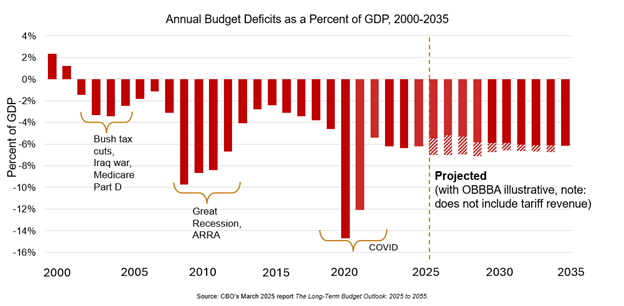
A growing number of fiscal experts and policymakers—including Treasury Secretary Scott Bessent and financier Ray Dalio—are coalescing around the idea that reducing the federal deficit to 3% of gross domestic product (GDP) is a critical first step toward stabilizing the national debt. This target is grounded in economic fundamentals: when deficits stay below the rate of economic growth, the debt-to-GDP ratio levels off, preventing the debt burden from rising indefinitely. With deficits currently projected to average around 6 percent of GDP over the next decade, and debt held by the public on track to exceed 120 percent of GDP by the mid-2030s, the 3% benchmark offers a realistic short term target, that could be a first step to helping put the country on a more sustainable path.
Where We Are: A Budget Deep in the Red
The U.S. federal deficit for fiscal year 2025 is projected to hit $1.9 trillion, or 6.2 percent of GDP. That’s nearly double the 50-year average of 3.8 percent. For context, deficits peaked at 29.6% of GDP during World War II and was 14.7% during the COVID-19 pandemic. But today’s deficits are unusually high for peacetime, and they’re being driven not by war or a global pandemic, but by structural imbalances: aging demographics, rising interest costs, and tax policies that don’t match spending levels.
Without corrective action, the debt burden will continue to outpace economic growth, creating a long term drag on the economy and stalling growth as well as leaving the U.S. more vulnerable to fiscal shocks and reducing the government’s flexibility to respond to future crises.
Why 3 Percent is a Good Initial Target: Debt Stabilization Math
Here’s the core logic: If the economy grows at roughly 3 percent annually and the deficit is kept at or below 3 percent of GDP, then the debt-to-GDP ratio stabilizes. That’s because the numerator (debt) and denominator (GDP) grow in tandem. Anything above that threshold means debt grows faster than the economy, increasing the debt burden over time. Between 1954 and 2004, GDP growth averaged 3 percent.
Treasury Secretary Bessent’s “3-3-3” plan—targeting 3% GDP growth, 3% deficit, and 3 million barrels/day in new oil production—is built around this stabilizing idea. While the path to lowering the deficit to 3% of GDP while maintaining strong economic growth requires challenging policy choices, there is a logic to the target. And reducing the deficit could, in and of itself, help strengthen the economy by restoring confidence in the country’s fiscal solvency and potentially helping lower interest rates.
Bessent has urged President Trump to publicly commit to the 3% target, framing it as a bipartisan goal akin to the fiscal discipline of the late 1990s. In that era, despite making tough economic choices that raised taxes and cut spending, the country saw budget surpluses, strong economic growth, and a debt-to-GDP ratio that actually declined.
The 3% benchmark is just a target, however, and there are many challenges that suggest it should be a milepost but not an endpoint in our deficit reduction journey. The first challenge is that few economists actually think the economy will grow at 3% over the next ten years. In fact, most forecasters project growth will be closer to 2%. Further, the pure interest costs of financing debt that is the same size as our economy will continue to put internal pressure on our budget. If we can move to an actual balanced budget in a disciplined fashion over time, we will then see debt to GDP decline to more reasonable levels leaving the country in a much stronger position for the future.
Dalio’s Warning: The Debt Bomb Is Ticking
Ray Dalio, founder of Bridgewater Associates, has recently taken a prominent role in sounding the alarm about growing debt. In a 2025 interview, he warned that America’s borrowing pace is “very much analogous to the years before World War II,” and that “when debt grows faster than income, it’s like plaque in the arteries.” His analysis suggests that to avoid a serious fiscal crisis, policymakers must shift the U.S. debt trajectory from its current unsustainable path to one that aligns with a 3% deficit target. He lays out a set of policy changes that would be a mix of spending restraint, revenue increases, and lower interest costs that could get the United States to the 3% target. According to Dalio, this “3% solution” would dramatically reduce the risk of a debt-driven economic shock, protecting the government, its creditors, and the broader economy from what Dalio warns could be a financial “heart attack.”
Conclusion: A Compass for Fiscal Sustainability
A 3% deficit target isn’t a silver bullet, but it’s a very solid first step. Further it would signal seriousness, impose discipline, and begin to align fiscal policy with economic reality. And as history shows, when America sets clear fiscal goals and sticks to them, it can restore trust, resilience, and room to maneuver. We have balanced the budget before and we can do it again.
Continue Reading