Concord Action welcomes a variety of viewpoints on issues related to the long-term fiscal health of the nation. The following guest essay is written by Kurt Couchman, who is senior fellow in fiscal policy at Americans for Prosperity and the author of Fiscal Democracy in America: How a Balanced Budget Amendment Can Restore Sound Governance (2025). He previously conducted government affairs for the Committee for a Responsible Federal Budget, Defense Priorities, and the Cato Institute, and he staffed several members of the U.S. House of Representatives.
Elevate America with a Next‑Generation Balanced Budget Amendment
A renewed push for a Balanced Budget Amendment
A new proposal to amend the U.S. Constitution with a Balanced Budget Amendment (BBA) is headed to the House floor. The idea isn’t new: Congress came close to passing a BBA in 1995, but interest is rising again as the federal debt grows, borrowing costs climb, and the specter of a debt crisis looms. A constitutional requirement to keep spending and revenue in line would help Congress prevent the kind of large chronic deficits the country faces today.
Why the idea is resurfacing
The federal government is once again running large deficits, and interest payments take up a growing share of the budget. Many lawmakers in both parties say they want to reduce borrowing, but the political system often rewards short‑term decisions over long‑term discipline. Like any constitutional provision, a BBA would push Congress to make more responsible choices.
Nearly all U.S. states—and many other advanced countries—operate under some form of balanced budget requirement. In the states, these rules are often backed up by additional laws and by pressure from bond markets, which reward fiscal stability.
What a BBA is meant to accomplish
A constitutional requirement to balance the budget would:
- Encourage Congress to focus on high‑value programs and eliminate wasteful or low‑priority spending.
- Slow the growth of federal debt by ensuring that spending doesn’t consistently outpace revenue.
- Strengthen “fiscal democracy” by giving individual legislators more room to shape policy rather than relying on top‑down deals or last‑minute negotiations.
Polls show broad public support for the idea. Many Americans believe the federal government should follow the same basic budgeting discipline expected of households and states.
What a modern Balanced Budget Amendment looks like
Earlier BBA proposals often ran into political and practical concerns. Some were seen as too rigid, while others included exceptions or requirements that made bipartisan support impossible. Newer proposals avoid those pitfalls and are often more principles-based than mechanical. Amendments can only succeed with broad, bipartisan support because they require approval by two-thirds of both houses of Congress and then by three-fourths of state legislatures or conventions.
Why annual balance is not the right goal
One of the biggest lessons from past debates is that requiring the budget to balance every single year can backfire. Revenue naturally rises and falls with the economy (see Figure 1). If the government were forced to cut spending sharply during a recession just to hit an annual target, it could make economic downturns worse.
Figure 1: Stabilize budgeting with structural – not annual – balance
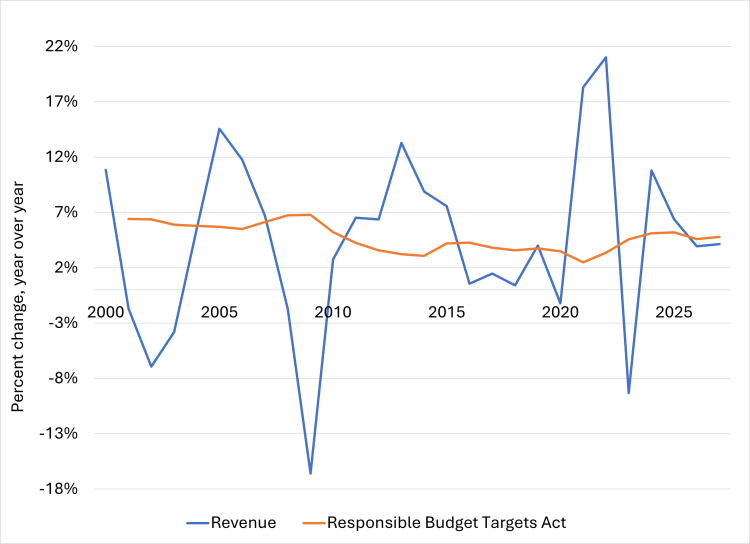 For that reason, newer proposals focus on medium‑term balance—making sure spending and revenue move in line over time, not necessarily every year.
Examples of next‑generation proposals
Several members of Congress have introduced updated versions of a BBA:
- The Principles‑Based BBA (Rep. Nathaniel Moran and Sen. Jon Husted)
Allows the budget to balance over the medium term, allows emergency borrowing with a two‑thirds vote, and gives the government ten years to reach balance after ratification. Implementing it could rely on the Responsible Budget Targets Act (Rep. Tom Emmer and then-Sen. Mike Braun), which provides mechanics that adjust for revenue changes (see orange line on Figure 1), safety net programs, and emergency borrowing.
- The Business Cycle BBA (Rep. Jodey Arrington)
Ties spending to the average revenue of the previous three years, which helps smooth out economic ups and downs. Also allows emergency borrowing with a two‑thirds vote. - Rep. Andy Biggs’ BBA
Similar to Arrington’s but includes additional features, such as suspending the balance requirement during declared wars and requiring a two‑thirds vote for certain revenue increases. - Rep. Tom McClintock’s debt‑limit amendment
Would eventually require three‑fourths of Congress to approve any increase in the federal debt limit.
These proposals differ in design, but they share a common goal: creating a stable, predictable framework that keeps spending and revenue aligned over time.
Strengthening the budget process beyond a BBA
A constitutional amendment alone won’t fix the federal budget. Congress must also modernize the way it does budgets and appropriations.
Two ideas frequently mentioned:
- Ending government shutdowns
Many Americans want Congress to stop using shutdown threats as leverage. The government should stay open while lawmakers are stuck in Washington until appropriations are completed. - Writing a full, comprehensive budget each year
Today, only about one‑quarter of federal spending goes through the annual appropriations process. The rest runs on autopilot. Congress should bring the rest of spending and revenue decisions into a unified budget that all committees help shape. The Comprehensive Congressional Budget Act will let committees manage mandatory spending and revenue policy alongside annual appropriations.
Combining a BBA with a more complete and transparent budget process would give Congress better tools to manage the nation’s finances responsibly.
A constitutional anchor for long‑term fiscal health
A Balanced Budget Amendment would provide a durable, widely understood commitment to sustainable budgeting. Newer proposals avoid the flaws that sank earlier versions and could attract the bipartisan support needed for ratification.
The core idea is simple: a constitutional rule would help Congress make better decisions, reduce the debt burden on future generations, and strengthen public trust in government.
Continue Reading