The Congressional Budget Office’s (CBO) Budget and Economic Outlook: 2026 to 2036 delivers a stark message: federal budget deficits are projected to keep rising, pushing the national debt to unprecedented levels. Even with steady economic growth, the government is expected to borrow far more than it has historically, driven by rapidly increasing interest costs, recent policy decisions, and a structural gap between spending and revenue. The resulting fiscal trajectory is not only unsustainable but drifting steadily in the wrong direction.
Deficits Continue to Grow and Debt Will Reach Historic Levels
CBO projects that the budget deficit will reach $1.9 trillion in 2026 and grow to $3.1 trillion by 2036. As a share of the economy, the deficit rises from 5.8% of gross domestic product (GDP) in 2026 to 6.7% in 2036.
Deficits of this size were once rare. From 1947, just after World War II, through 2008, the annual deficit NEVER exceeded 6% of GDP. Since 2008, deficits have topped that level six times, driven by the financial crisis and the pandemic. Now, even without a major war, financial crisis, or global pandemic, CBO expects deficits to average 6.1% of GDP over the next decade.
With large deficits continuing year after year, federal debt held by the public is projected to rise from 101% of GDP in 2026 to 120% in 2036. That would exceed the previous record of 106% of GDP, set in 1946 at the end of World War II. The United States has never carried debt this high during peacetime.
Policy Changes Impacting the Deficit
Recent policy actions have also reshaped the fiscal landscape.
- The 2025 reconciliation act (Public Law 119‑21) increased projected deficits by $4.7 trillion after accounting for economic effects and added interest costs.
- Administrative actions related to immigration added another $0.5 trillion.
- Higher tariffs reduced projected deficits by $3.0 trillion, including their economic and interest effects. Tariff revenue assumptions are particularly uncertain because tariffs imposed through executive action can change frequently and are currently the subject of a pending Supreme Court decision.
Taken together, along with other economic and technical revisions made by CBO, these policy changes leave cumulative deficits for 2026–2035 about $1.4 trillion (6%) higher than CBO’s 2025 baseline.
Rising Interest Costs Are Driving the Growth in Deficits
A major factor behind the worsening fiscal outlook is the rapid growth in net interest costs. These payments are rising much faster than other parts of the budget.
- Net interest costs as a share of GDP increase from 3.3% in 2026 to 4.6% in 2036 – more than double the 50-year average of 2.1%.
- When interest payments are excluded, the deficit actually declines between 2026 and 2036 from 2.6% to 2.1% of GDP.
- Interest payments already exceed defense spending; by 2028, they are projected to surpass Medicare and by 2036 nearly match all discretionary spending.
- Net interest is projected to rise from 19% of federal revenue in 2025 to 26% in 2036. In practical terms, that means more than one out of every four tax dollars will go toward interest payments rather than services, benefits, or investments that directly support the public.
This surge reflects both the rising federal debt and CBO’s expectation that long‑term interest rates will remain higher than previously assumed.
 Structural Spending and Revenue Gap Leads to Higher Deficits
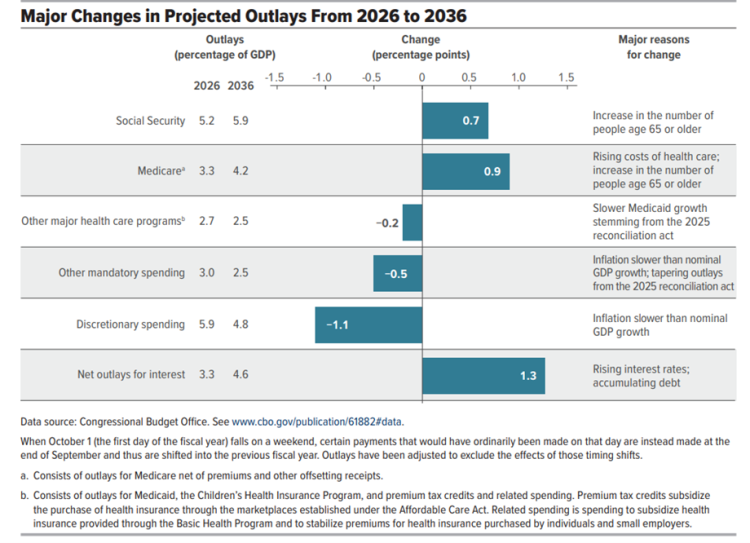
The long‑term gap between spending and revenue remains at the heart of the fiscal challenge. Federal outlays total $7.4 trillion in 2026, or 23.3% of GDP. Spending rises to 24.4% of GDP in 2036—well above the 50-year average of 21.2%. The primary spending changes over this period are (see chart above):
- Social Security and Medicare outpacing the growth of GDP by 0.7 and 0.9 percentage points, respectively. This growth is due, in large part, to the aging of the population.
- Net interest payments that are projected to grow an astounding 1.3% points faster than GDP.
- Declining discretionary spending, which only partially offsets these increases.
Revenues are projected to be $5.6 trillion in 2026, or 17.5% of GDP. By 2036, they rise to $8.3 trillion, or 17.8% of GDP—slightly above the long‑term average, mainly because of higher tariff collections. But even with that boost, revenues remain well below the levels seen the last time the federal budget was balanced, when they averaged 19.4% of GDP from 1997 to 2001.
The deficit math is both simple and alarming. By 2036, federal spending is projected to reach 24.4% of GDP, while revenues total just 17.8%—a gap that produces a deficit of 6.7% of GDP.
Conclusion
CBO’s latest outlook makes one thing unmistakably clear: the federal budget is on a path that cannot be sustained. Deficits are rising even in stable economic conditions, interest costs are consuming a growing share of federal resources, and the structural mismatch between what the government spends and what it collects continues to widen. None of these trends will correct themselves. They are the predictable result of policy choices, demographic pressures, and the absence of durable fiscal guardrails.
The sooner the nation begins to address these challenges, the more manageable the solutions will be. CBO’s outlook is a warning, but it is also an opportunity: a chance to build a more stable fiscal foundation before the choices become far more difficult.
Continue Reading