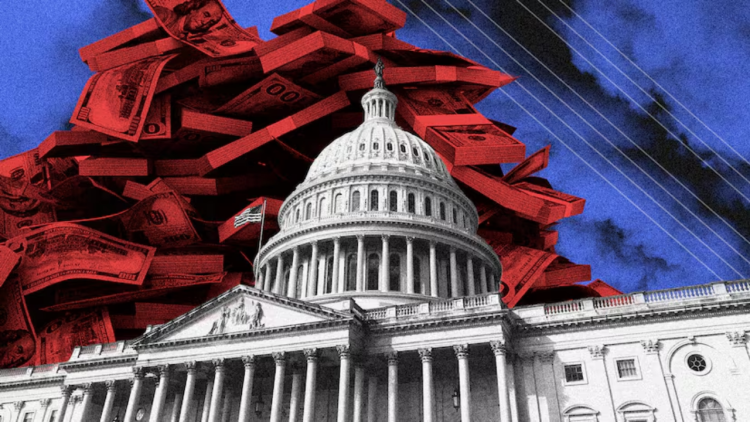
The federal debt has ballooned over the past two decades, with deficits growing year after year and little to stop them. Between 2010 and 2024 alone, the national debt surged by nearly $22 trillion. Despite repeated warnings from economists and watchdogs, the budget process remains riddled with loopholes and lacks the enforcement tools necessary to ensure fiscal discipline. One of the most glaring examples is the erosion of the Pay-As-You-Go (PAYGO) rules—once a cornerstone of responsible budgeting.
The “pay-as-you-go” (PAYGO) framework was first enacted into law in 1990 to prevent new legislation from worsening the deficit. Though embraced by both parties and reinforced through statutory changes and chamber-specific rules, PAYGO has been repeatedly weakened and sidestepped—especially to pass expensive tax cuts and spending bills. Once a strong tool for budget discipline, it now serves as a glaring example of fiscal policy failure. This blog examines PAYGO’s decline and explores how it can be restored to help rein in the federal deficit.
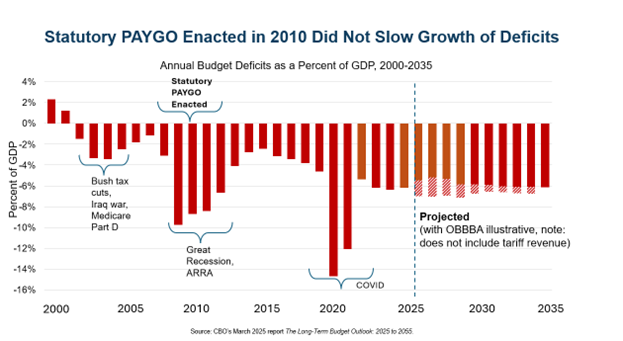
Statutory PAYGO Has Failed to Slow the Growth of Deficits
The current version of statutory PAYGO, passed in 2010, is a budget enforcement mechanism and designed to prevent new legislation from increasing the federal deficit. It applies to mandatory spending and tax changes, requiring that any new law affecting these areas must be offset by equivalent savings or revenue increases. If legislation adds to the deficit, its impact is recorded on an annual scorecard covering five- and ten-year periods. A negative balance on this scorecard triggers automatic spending cuts—known as sequestration—after Congress adjourns for the year.
However, several exceptions apply. Off-budget entities like Social Security and the Postal Service are excluded from PAYGO calculations. Certain costs—such as emergency spending, debt service, timing shifts, and specific tax and Medicare provisions—are exempt. If sequestration is triggered, cuts are limited: Medicare faces a maximum 4% reduction, and many safety net programs like Medicaid, SNAP, and unemployment insurance are fully protected from budget cuts. Tax increases are not included as a potential deficit offset. Congress can waive PAYGO, but doing so requires a 60-vote supermajority in the Senate and a simple majority in the House.
Since the enactment of the PAYGO law in 2010, both parties in Congress have passed deficit-increasing legislation that, under the law, should have triggered automatic spending cuts (sequestration)to offset the fiscal impact. Yet despite these requirements, Congress has consistently taken steps to avoid enforcement, and the sequestration process required by the 2010 PAYGO law has never been used to reduce the deficit. For example,
- 2017 Tax Cuts and Jobs Act (Republican-led): Enacted under President Trump, this reconciliation bill was projected to increase the deficit by $1.46 trillion over 2018–2027. Although the bill itself lacked a PAYGO waiver, Congress passed separate legislation the same day to prevent automatic spending cuts, effectively sidestepping PAYGO enforcement.
- 2021 American Rescue Plan Act (Democratic-led): Enacted under President Biden, this reconciliation bill was projected to increase the deficit by approximately $1.86 trillion over FY2021–FY2030. Subsequent legislation delayed PAYGO scorecard debits to future years, ultimately nullifying them through additional legislative maneuvers.
Even if Automatic Cuts Are Triggered – They Come Up Short
A recent Congressional Budget Office report estimates that passage of the One Big Beautiful Bill Act (OBBBA) would require, under statutory PAYGO, spending cuts totaling $415 billion in fiscal year 2026 to offset the increase in the deficit. However, the budget cuts allowed by the PAYGO law, after excluding exempt programs and the limit on Medicare cuts, total only $165 billion. So even if the PAYGO law is not waived, which it likely will be, the required spending cuts would offset less than half of the deficit increase.
Senate PAYGO Has Not Prevented Large Deficit Increases
The Senate PAYGO rule, first established in 1993, prohibits consideration of legislation that would increase on-budget deficits in any of four fiscal periods: the current year, the budget year, the next six years, or the next eleven years. To advance such legislation without offsetting provisions, a supermajority of 60 Senators must vote to waive the rule. Between its inception and the end of the 117th Congress, the rule was invoked to block 49 amendments, while the Senate voted to waive it 19 times, illustrating both its procedural significance and the frequency with which it has been bypassed. However, the Senate rule failed to prevent the bills that resulted in the largest deficit increases.
House CUTGO Rule Does Not Apply to Tax Cuts
The current House CUTGO rule, which has been in place since 2023, prohibits consideration of legislation that would increase mandatory spending over either a six-year or eleven-year budget window, but notably excludes revenue effects. This means the House can pass bills that reduce revenues—even if they increase deficits—without triggering the rule. Unlike the Senate PAYGO rule, which requires a 60-vote supermajority to waive, the House rule is easier to circumvent: it is not self-enforcing and can be waived by a simple majority through a special rule, by unanimous consent, or by using suspension procedures. As a result, enforcement depends entirely on whether a Member raises a point of order. The exclusion of revenue effects has meant that the over $4 trillion in tax cuts included in the One Big Beautiful Bill Act of 2025 were not subject to the House CUTGO rule.
Congress Needs to Fix PAYGO
The PAYGO system is broken. PAYGO requirements are routinely waived and legislation that increases the deficit passes routinely without any offsets to mitigate the deficit impact. Statutory PAYGO needs to be reformed and updated so that it is an effective budget enforcement tool.
- Reform Statutory PAYGO: The vote threshold to waive sequestration should be raised in the house to a three-fifths majority to align with the Senate. The list of programs available for automatic sequestration should be expanded and tax increases should be added as an alternative to sequestration.
- Use PAYGO to lower the deficit: The Committee for a Responsible Federal Budget has proposed Super PAYGO in which every dollar of new spending or tax cuts would be offset by at least two dollars of revenue increases or spending reductions, thus ensuring that new tax cut and mandatory spending legislation also includes deficit reduction.
Conclusion
PAYGO was designed to enforce fiscal discipline, but today it’s riddled with exemptions, routinely waived, and ineffective at curbing deficit growth. Both parties have exploited its weaknesses to pass costly legislation without offsets, contributing to trillions in new debt. Strengthening PAYGO—by raising waiver thresholds, expanding sequestration options, and adopting reforms like Super PAYGO—would restore its credibility and help ensure that new legislation doesn’t worsen our fiscal outlook. It’s time for Congress to treat budget enforcement not as a formality, but as a foundation for long-term sustainability.
Continue Reading