With the passage of the One Big Beautiful Bill Act (OBBBA), Congress has wrapped up this year’s budget reconciliation process. That landmark legislation added $4.1 trillion to federal deficits (including interest), underscoring just how powerful—yet risky—the reconciliation tool can be. Originally designed to help reduce deficits, reconciliation now often serves as a fast-track vehicle for partisan priorities with major budget consequences.
Now, the spotlight turns to appropriations, the more granular process that keeps the government running year to year. While reconciliation affects mandatory spending—programs like Social Security, Medicare, and Medicaid that run on autopilot—appropriations deal with discretionary spending, which includes things like education, transportation, research, and defense. Discretionary funds must be approved annually.
It’s also a moment to highlight who handles what. Authorizing Committees—such as Ways and Means, Energy and Commerce, and Finance—craft laws governing mandatory programs and often drive reconciliation legislation. In contrast, the Appropriations Committees in both chambers oversee the twelve annual spending bills that determine discretionary funding levels and are divided into twelve subcommittees with jurisdiction over the spending levels of specific Federal agencies.
Are We Heading Towards a Government Shutdown?
Congress faces a September 30 deadline to fund the government before the new fiscal year starts on October 1. If lawmakers don’t pass all 12 appropriations bills in time, they’ll need to approve a short-term funding measure—known as a Continuing Resolution (CR)—to provide funding for any agencies that have not been funded by a full-year appropriation or risk a partial government shutdown.
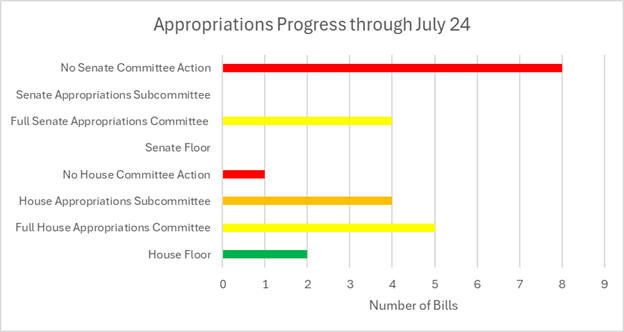
With the August recess approaching, progress has been uneven: the House has advanced ten bills (two passed on the floor, nine out of at least the subcommittee), while the Senate has moved only four none of which have passed on the floor (see Figure 1). That leaves little time, with only about two dozen legislative days left to finalize everything.
Political tensions add to the challenge. In the Senate, bills need 60 votes, requiring bipartisan cooperation—tough in today’s polarized climate. Recent party-line votes on a $9 billion rescissions package, which only require a simple majority to pass, have shaken trust, especially among Democrats, who worry that any bipartisan funding deals could later be reversed.
There’s also friction between House and Senate Republicans. Last month, Senate changes to a major spending bill added around $1 trillion in costs, which the House had to accept under pressure. That frustration could fuel resistance to future compromises—and increase the risk of a shutdown.
Figure 1
Conclusion
As Congress pivots from reconciliation to appropriations, the stakes shift from long-term fiscal impacts to the immediate need to keep the government running. With limited time, partisan tension, and unresolved funding disputes, the path to avoiding a government shutdown is anything but certain. Whether lawmakers can put aside differences and pass all twelve bills—or settle for another stopgap measure or a government shutdown—will shape not just the fiscal year ahead, but public confidence in the legislative process itself.
Continue Reading