As Medicare marks its 61st anniversary, it’s a timely moment to reflect on how this cornerstone program has evolved, not only in the lives it touches but also in its share of the federal budget. Since its inception, Medicare has expanded significantly, influenced by both demographic shifts and important policy changes. This growth has prompted mechanisms like the “Medicare trigger,” an effort by Congress to try to keep the program from consuming an ever growing share of general revenue. Yet, despite its intentions, the trigger has been ineffective.
Medicare’s Growing Share of the Federal Budget
Medicare was established primarily to provide health insurance for Americans aged 65 and older. Over the decades, as the baby boomer generation aged and life expectancy increased, the number of beneficiaries has surged. This demographic change alone has put upward pressure on Medicare spending. As the figure below shows, Medicare has grown as a share of the budget over the past several decades, from just 5 percent in 1975 to 17 percent in 2025.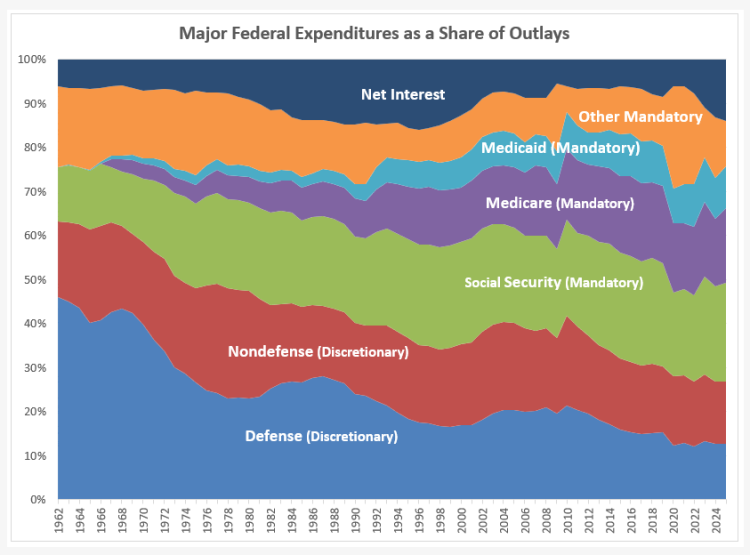 Source: Congressional Budget Office, The Budget and Economic Outlook: 2026 to 2036, Supplemental Historical data.
Policy expansions have also contributed. Notably, the Medicare Prescription Drug, Improvement, and Modernization Act of 2003 introduced Medicare Part D, which had the effect of significantly increasing the program’s scope and reliance on general tax revenues (as opposed to payroll taxes or premiums which also help finance key portions of the Medicare program as a whole). Additionally, the shift toward more outpatient services under Medicare Parts B and D has altered spending patterns, often increasing costs covered by general revenues.
The combined effect of these factors has meant that Medicare’s share of general revenues has grown steadily, raising concerns about its long-term fiscal sustainability.
Understanding the Medicare Trigger
In response to growing concerns about Medicare’s impact on the federal budget, Congress enacted Medicare “trigger” provision as part of the 2003 Medicare Prescription Drug, Improvement, and Modernization Act. The trigger is a fiscal early warning system that focuses on the proportion of Medicare spending financed by general revenues rather than dedicated sources like payroll taxes and premiums.
Specifically, the Medicare Board of Trustees must annually determine whether general revenue funding for Medicare as a whole is expected to exceed 45% of total Medicare outlays in the current or next six fiscal years. If this threshold is exceeded two years in a row, a Medicare funding warning is triggered. This requires the President to submit proposed legislation to address the issue, and Congress is supposed to consider the proposal under expedited procedures.
The trigger’s goal was to spotlight Medicare’s growing demand on general revenues and prompt timely legislative action to curb spending or increase dedicated funding.
Why the Medicare Trigger Has Fallen Short
The most recent Medicare Trustees report found that general revenue funding exceeds 45% in fiscal year 2026, the first year of the projection. This is the second consecutive year of such a finding, which means that a Medicare funding warning has been issued. This is the ninth consecutive year that a Medicare funding warning has been issued. Despite these repeated warnings, issued under both Democratic and Republican administrations, the trigger has not succeeded in controlling Medicare’s growth or limiting its reliance on general revenue subsidies. Several factors contribute to this:
- No Binding Enforcement: The trigger mandates that the President submit legislation and that Congress consider it expeditiously, but it does not require that legislation be enacted or spending be cut. Thus, there is no automatic mechanism to enforce fiscal restraint.
- Presidential Discretion and Constitutional Concerns: Presidents have expressed constitutional objections to being compelled to submit legislative proposals, viewing the requirement as advisory rather than mandatory. To date, only the Bush administration submitted a proposal in response to a funding warning in 2008, and even then, Congress did not act on it.
- Complex Funding Structure: Medicare’s financing is split between two trust funds — Hospital Insurance (HI) for Part A, funded mainly by payroll taxes, and Supplementary Medical Insurance (SMI) for Parts B and D, funded largely through general revenues and premiums. Because the trigger combines these funds in its calculation, legislative or policy changes affecting one part may not effectively reduce overall general revenue reliance.
- Legislative and Political Challenges: Even with expedited procedures, Congress has not passed legislation specifically aimed at lowering general revenue Medicare funding below the trigger level. Political priorities, competing budget demands, and the complexity of Medicare reforms have limited action.
Looking Ahead
Medicare continues to be a vital program serving millions of Americans, but its growing budgetary footprint poses challenges. The Medicare trigger was an innovative attempt to provide early warnings and prompt action, but its limitations highlight the difficulty of controlling healthcare spending through procedural mechanisms alone.
As we celebrate Medicare’s anniversary, it may be time to consider whether more robust or alternative approaches are needed — perhaps ones that better address the underlying demographic and policy drivers of costs, and that ensure accountability in managing Medicare’s financial future.
Continue Reading