James Carville once joked that if he were reincarnated, he’d want to come back as the bond market because “you can intimidate everybody.” For decades, that line captured the market’s reputation as the ultimate disciplinarian of fiscal policy. And while the bond market hasn’t exerted that kind of power in the United States for quite some time, recent developments suggest we may be entering a period when its influence is growing again.
Below is a walkthrough of how the major parts of the bond market work, and why rising interest rates matter not just to Wall Street, but to the federal budget.
1. The Treasury Borrowing Process: Auctions and Yields
The federal government borrows money by issuing Treasury bills, notes, and bonds, each with different maturities, through regularly scheduled auctions. Investors bid on these securities, and the auction determines the yield, which is effectively the price of borrowing. Higher yields mean investors demand more compensation because they perceive greater risk or uncertainty.
Recent Treasury auctions have shown exactly that dynamic. When demand is weaker, yields rise, signaling that investors want a higher return to hold U.S. debt. Last week’s 10‑year Treasury auction cleared at a 4.68% yield, the highest since 2007 and well above CBO’s projection of 4.1% for this year. A day later, the Treasury’s 30‑year bond auction sent an even stronger signal, with yields hitting 5.22%, the highest since 2001. Both auctions are a sign that investors are becoming more cautious about inflation, geopolitical risk, and the nation’s fiscal trajectory.
2. The Secondary Market: Constantly Moving Yields
Once a Treasury bond is issued, it begins trading in the secondary market, where investors buy and sell existing bonds. Unlike the auction market, these trades happen continuously, and yields move constantly in response to new information.
Bond prices and yields move inversely: when prices fall, yields rise. Today, 30-year market yields are at their highest levels in over two decades (see the Figure 1 below), reflecting expectations of higher inflation, larger federal borrowing needs, and uncertainty about the economic outlook. AI firms that once paid for massive capital investments, such as data centers, out of operating cash flow are now turning to debt to fund those projects. This means greater demand for borrowing which pushes yields higher. Even without a new auction, the secondary market can push borrowing higher for the government by setting the benchmark for future auctions. The 10-year market yield is also trending upward and is currently above 4.6%.
Figure 1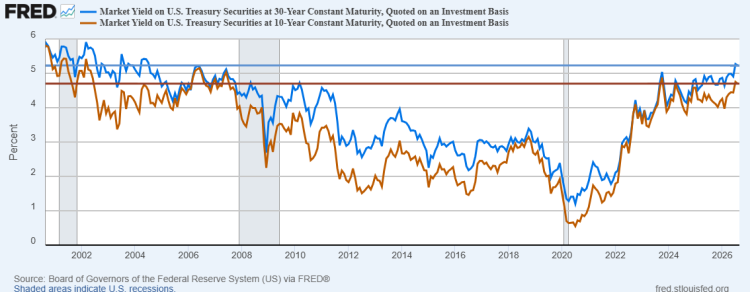 In response to higher long-term bond yields, last week Treasury Secretary Scott Bessent announced and executed a targeted buyback of longer‑term Treasuries intended to temporarily push down long‑term yields amid rising borrowing costs. The operations produced a brief dip in yields, but as Stanley Druckenmiller, a former hedge fund manager and billionaire, argued in the Wall Street Journal: the buybacks are a short‑term fix that won’t counteract heavy new issuance, risk distorting markets, and could undermine confidence.
3. The Federal Reserve: Short‑Term Rates and Market Expectations
The Federal Reserve influences interest rates by setting the federal funds rate—the short‑term rate at which banks lend to one another. These decisions ripple through the economy, affecting everything from mortgage rates to corporate borrowing costs.
Figure 2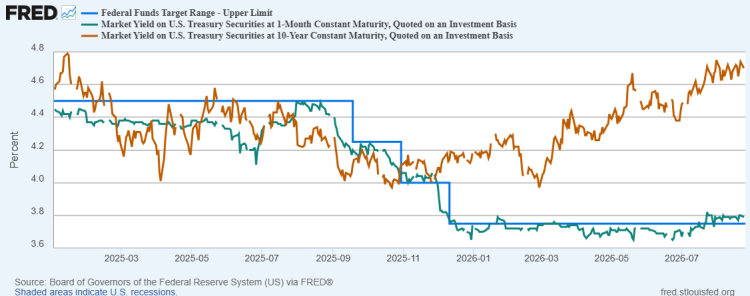 But right now, something unusual is happening: The Fed has held its policy rate steady for about a year, yet as market interest rates on short-term bonds (1-month as shown in Figure 2) continue to track the Federal Funds rate, the market yield on longer-term bonds continues to diverge from the yield on short-term bonds and rise.
Why? Investors expect inflation to remain elevated and see growing risks tied to America’s rising debt and deficits. Those concerns push long‑term yields higher even without Fed action. In other words, the bond market is asserting its own judgment about economic conditions, and that judgment is showing up in higher borrowing costs. Also, the new Federal Reserve Chair Kevin Warsh has broken precedent by not providing a signal as to whether the Federal Reserve will increase or lower interest rates in the future. This uncertainty has contributed to the increased risk associated with long term-treasury notes and bonds.
4. Why Rising Interest Rates Matter for the Federal Budget
Higher interest rates directly increase the cost of servicing the national debt. When Treasury issues new bonds at higher yields, or refinances maturing debt into a higher‑rate environment, interest costs rise. With more than $30 trillion in publicly held debt, even small increases in rates translate into large increases in annual interest payments.
This means:
- More federal dollars go toward paying interest rather than funding programs.
- Deficits grow faster, because interest costs compound over time.
- Reduces flexibility because the cost and even ability to borrow might limit policymakers’ ability to respond to future crises..
In short, when the bond market starts demanding higher yields, the federal budget feels it—quickly and powerfully.
CBO’s 10‑year baseline assumes that interest rates on 10‑year Treasury securities will be about 4.1% in 2026 and average roughly 4.4% over the decade. But as noted above, current market rates are closer to 4.7 percent. CBO estimates that every 0.1‑percentage‑point increase in the 10‑year rate adds about $379 billion in net interest costs over ten years. That means if rates average 4.7% instead of 4.4%, the federal government would face more than $1 trillion in additional interest costs over the decade.
Currently the average interest rate on US treasury debt is 3.44% which is well below market rate. However, as the Treasury rolls over the national debt (with about 1/3 maturing in one year) there will be significant exposure to these higher rates going forward.
The Bottom Line
Carville’s quip may feel newly relevant. For years, low interest rates muted the bond market’s influence on fiscal policy. But with auction yields rising, secondary‑market rates climbing, and investors increasingly focused on inflation and debt sustainability, the bond market is once again becoming a force policymakers cannot ignore.
If this trend continues, interest costs will play an even larger role in shaping America’s fiscal future—and the choices facing Congress.
Continue Reading