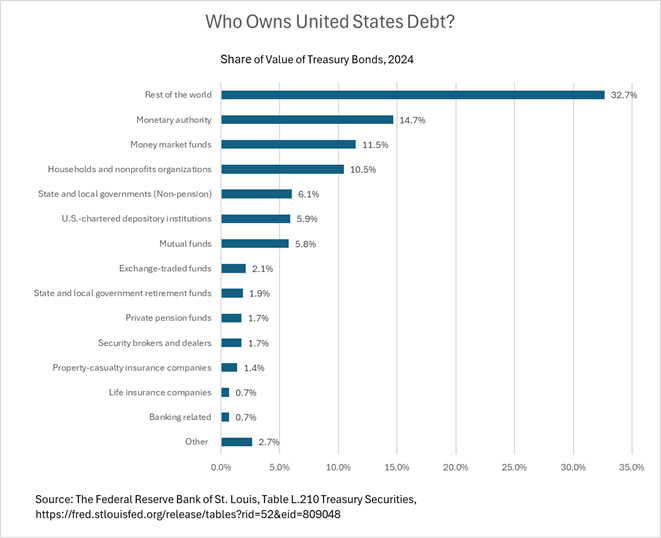
Ownership of U.S. Treasury bonds is widely dispersed across foreign governments, the Federal Reserve, financial institutions, state and local entities, and individual households (see chart). This diversity may bolster market liquidity, but it also amplifies risk: federal debt is woven deeply into the balance sheets of nearly every economic sector.
- Systemic Exposure: From banks and pensions to households and governments, many sectors have staked significant resources in Treasury securities. Rising interest rates and mounting debt service costs threaten to strain budgets and financial stability across the board.
- Foreign Reliance: With nearly one-third of U.S. debt held overseas, geopolitical shocks or shifting investor confidence could make U.S. borrowing more volatile and expensive. Fortunately the risk of volatility from the actions of a single country is fairly low because foreign debt holdings are not highly concentrated with the largest shares held by Japan (4%), the United Kingdom (3%), and China (3%).
- Public Sector Vulnerability: State and local governments—especially retirement systems—use Treasuries as a bedrock investment. A worsening fiscal outlook could limit their flexibility to meet future obligations or respond to local challenges.
- State and local governments, excluding pension funds, held 6.1 percent of U.S. Treasury bonds at the end of 2024, valued at $1.6 trillion. These bonds in many cases are short term investments of pooled cash to generate interest earnings over the course of the fiscal year.
- State and local pension funds hold $490 billion in US treasuries, about eight percent of state and local pension assets that totaled $6.1 trillion in 2024.
- Institutional Sensitivity: Mutual funds, insurers, and money market vehicles rely on Treasuries for safety and liquidity. Any disruption—be it a downgrade or sudden selloff—could ripple through financial markets, affecting everyday savers and retirees. The money market asset class, valued at more than $7 trillion at the end of 2024, held 41 percent of its funds in U.S. treasury bonds.
Federal Reserve’s Role in Holding U.S. Debt
About 14.7% of U.S. Treasury bonds are held by the monetary authority sector—primarily the Federal Reserve and its regional banks. These institutions play a central role in managing the nation’s money supply by providing funds to banks and absorbing excess cash. They hold large amounts of Treasury bonds to help steer interest rates and stabilize the economy.
Historically, these government bonds have been the Fed’s biggest asset—tools it buys and sells to influence inflation, employment, and borrowing costs. Its main liabilities include the cash in circulation and reserves held by banks. The central bank doubled its holdings of Treasury securities during the COVID-19 pandemic as part of its effort to mitigate the economic impact of the pandemic. However, since June 2022, the Fed has been reducing the size of its balance sheet in response to high inflation.
Conclusion
The chart underscores a simple but far-reaching truth: federal debt is no longer just Washington’s problem. It’s embedded in the economy’s nervous system. And as borrowing climbs without meaningful reform, the risks are increasingly shared—not just by policymakers, but by everyone with a stake in the system.
Continue Reading