Artificial intelligence has dominated headlines in recent weeks as developers race to build more powerful systems, policymakers debate appropriate guardrails, and the public grapples with questions about safety, privacy, and the future of work. Those concerns are important, and they deserve the attention they are receiving.
But AI’s influence extends well beyond technological and societal debates. Beneath the headlines, the rapid buildout of AI infrastructure is beginning to shape the economy in ways that could have consequences for the nation’s fiscal outlook. Building the data centers, computing networks, and energy infrastructure needed to power the AI revolution requires an unprecedented amount of capital, much of it financed through debt.
At the same time, the federal government is borrowing heavily to finance persistent budget deficits. As AI firms enter debt markets on an increasingly massive scale, they are competing alongside the Treasury for the same pool of investment capital. That competition, combined with other emerging pressures in the bond market, could contribute to higher interest rates and make financing the national debt more expensive.
The result is an underappreciated fiscal challenge: the unprecedented investment required to support AI development may also be reshaping debt markets in ways that increase the government’s borrowing costs. Understanding these trends is essential for policymakers seeking to navigate an increasingly complex fiscal landscape.
The AI Infrastructure Boom Is Unprecedented
The rate of growth in AI investment is already outpacing every other major infrastructure boom of the past two centuries, including railroads, canals, and the dot-com era (see Figure). In dollar terms, Goldman Sachs currently estimates roughly $765 billion (for context, that’s equivalent to about 10% of total Federal spending) in annual AI-related infrastructure spending across computer hardware, data centers, and power generation. That figure is projected to rise to approximately $1.6 trillion by 2031 (equivalent to more than 17% of Federal expenditures), with cumulative spending reaching $7.6 trillion between 2026 and 2031.
Figure: AI Investments Compared to Other Booming Technologies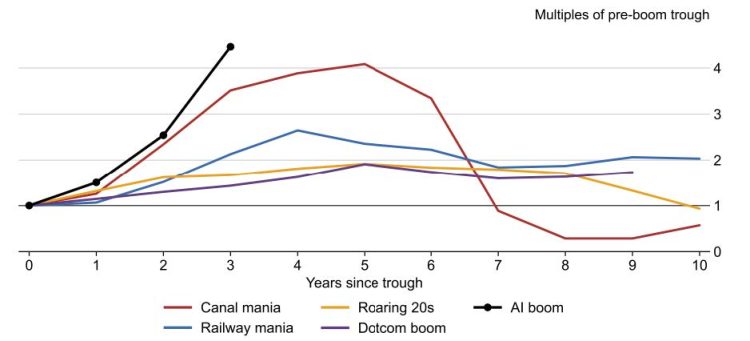
Source: Bank for International Settlements, The AI Investment Race, July 2026.
AI Firms Are Increasingly Turning to Debt Markets
Historically, many of the largest technology companies financed major infrastructure investments largely from their substantial cash reserves. As the scale of AI-related investment has expanded, however, firms have increasingly turned to debt markets to help fund hundreds of billions of dollars in new infrastructure. A recent Goldman Sachs estimate found $489 billion in AI-related debt issuance during the year, already surpassing the $322 billion recorded during the previous year. According to the Securities Industry and Financial Markets Association (SIFMA), the total US fixed income security (bonds) issued in 2025 was $11.5 trillion and the corporate portion was $2.2 trillion. That means debt financing of $489 billion for AI infrastructure is 4% of total bond issuance, and more than 20% of total corporate bonds.
This trend matters because debt markets are not limitless. As a growing number of AI companies seek financing, they are competing for capital with other borrowers, including the federal government.
More Competition for Capital Means Higher Borrowing Costs
When more borrowers pursue the same pool of investment capital, lenders typically demand higher yields. As a result, the AI buildout is creating an additional source of upward pressure on interest rates.
For private firms, higher rates increase the cost of financing new projects. For the federal government, they increase the cost of servicing the national debt. At a time when federal deficits remain elevated and Treasury borrowing needs continue to grow, even modest increases in yields can translate into significantly higher interest costs over time.
Continue Reading