The bond market has experienced significant volatility over the past several months, including a recent spike that has sent the yield on 10-year treasury bonds to its highest level, 5.28%, since 2002. In addition to inflation and competition from AI firms, discussed in previous blog posts, another factor driving volatility is the change in the mix of who owns US treasury bonds.
For much of the past two decades, the U.S. Treasury market was supported by a relatively stable group of buyers, including pension funds, the Federal Reserve and foreign governments. That dynamic is changing. As the Federal Reserve has reduced its balance sheet and overseas government demand has declined, investors who are more price sensitive have become the dominant purchasers of federal government debt. This shift has important implications for the world’s largest bond market, as discussed in more detail below.
Figure 1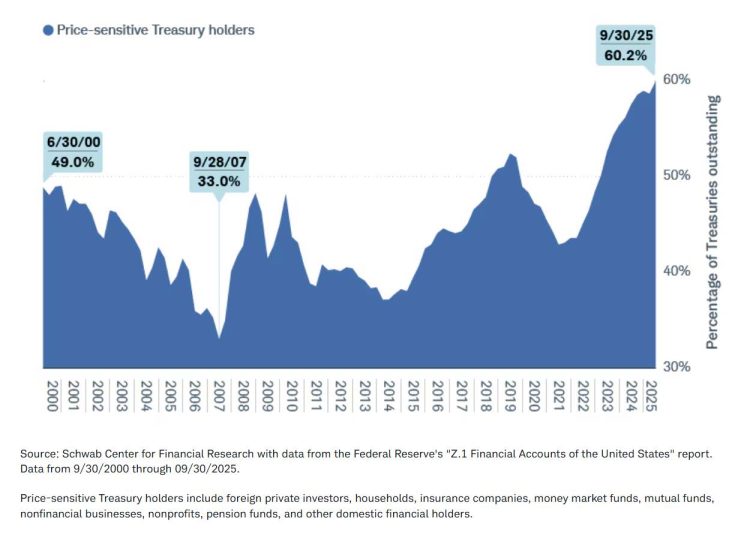
Private Investors Are Filling the Fed’s Retreat
The Federal Reserve—after doubling its Treasury holdings during the pandemic—began reducing its portfolio in mid‑2022 and continued doing so through the end of 2025. As the Fed stepped back, private investors both in the U.S. and abroad filled the gap. Hedge funds, households, money market funds, mutual funds, nonprofits, and other private buyers now hold roughly 60 percent of all outstanding Treasuries, up from just 37 percent in 2014 (see Figure 1).
Although the Federal Reserve, financial institutions, and foreign governments often purchase U.S. Treasuries to support market stability, manage liquidity, or meet policy goals, private investors approach the market differently. Their decisions are driven mainly by yield and overall returns. If they see better risk‑adjusted opportunities elsewhere, their demand for Treasuries can fall, a shift that may increase volatility in the market and require higher yields to attract new buyers.
Among the less price sensitive bond holders, foreign governments once played a much larger role in financing U.S. debt, peaking in 2014 when they held $4.1 trillion, or 34% of all publicly held Treasuries. Since then, their share has fallen by half to 17%.
Hedge Funds Are Emerging as a More Significant Treasury Player
One of the fastest growing sectors of price-sensitive bond holders are hedge funds. Over just two years, from 2023 to September 2025, hedge funds doubled their total Treasury exposure to about $4 trillion, including $2.4 trillion in bonds they own and $1.6 trillion in positions that bet on price movements. Their share of the entire Treasury market has grown from 4.5% to 8.5%, meaning a much larger portion of U.S. debt is now held by investors who react quickly to changes in risk, interest rates, and economic expectations.
Conclusion
The Treasury market remains deep and highly liquid, but the makeup of its investors is changing in meaningful ways. The Federal Reserve and foreign governments, traditionally viewed as relatively stable sources of demand, now account for a smaller share of the market than they did a decade ago. In their place, price-sensitive private investors have become the primary financiers of U.S. government debt.
This transition does not necessarily mean Treasury markets will become less resilient. However, it does mean that demand for government bonds may increasingly depend on market-based considerations such as yields, risk appetite, and relative investment returns. As a larger share of Treasuries moves into the hands of investors who can quickly adjust their portfolios, policymakers and market participants alike may need to pay closer attention not just to how much debt the government issues, but also to who is buying it.
Continue Reading