The Rising Cost of Interest: Why America’s Debt is Becoming More Dangerous
This year, financial markets have twice delivered the same unmistakable message: policy shocks can drive up the government’s borrowing costs in an instant. During “Liberation Day” in April 2025 and again when the administration floated tariffs on Europe as part of President Trump’s push to acquire Greenland, investors reacted by dumping Treasury bonds. In response the interest rate on 10‑year Treasuries jumped as sellers demanded higher returns to hold riskier assets. For a country carrying more than $30 trillion in debt held by the public, this kind of volatility isn’t just a market story. It’s a fiscal warning. ¹
When Cheap Borrowing Disappeared: How Rising Rates Exposed the True Cost of the Debt
Every year since 2001, the last time the Federal government ran a surplus, expenditures have exceeded revenues which means the country has run a deficit. To make up the difference, the United States incurs debt by selling Treasury bonds and using the proceeds to meet its expenditure obligations. The United States must pay those bonds back to investors who bought them, plus interest. The annual total of all the interest the government pays on the bonds held by the public is the total interest cost.
Figure 1
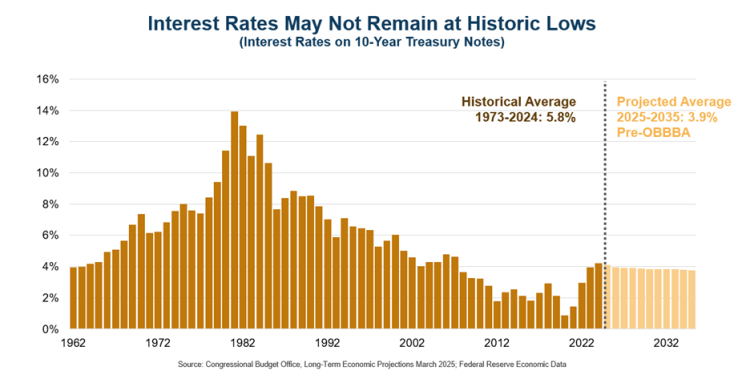
In the recent past, a growing national debt has not always meant rapidly increasing interest costs. From 2008 to 2013, the federal government benefited from an unusually forgiving interest rate environment (see Figure 1) as the nation grappled with the economic consequences of the Great Recession. The interest rate on 10-year Treasuries averaged below 3% for this period which, along with declining annual deficits, helped keep debt service costs stable, even as the national debt ballooned as a share of the economy from 64% to 100%.
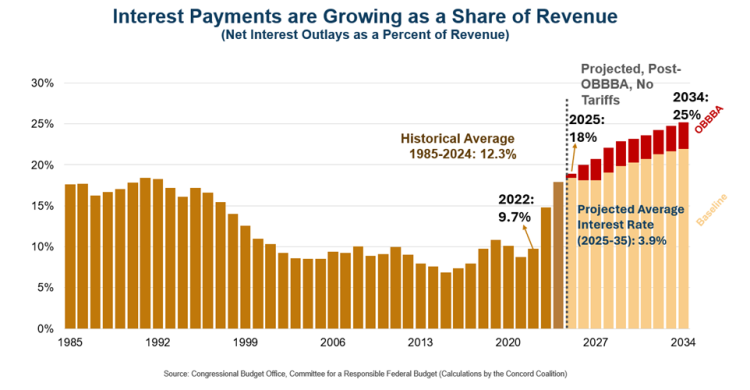
However, the period after the COVID pandemic shows the dramatic impact of rising interest rates. During 2020 and 2021, the US ran historically high peacetime deficits in excess of 12% of gross domestic product (GDP). Between 2022 and 2025 deficits were still elevated at about 6% of GDP, but were relatively stable. A common way to compare interest costs over time, and to other governments, is to analyze debt as a share of revenue. As Figure 2 shows, even though deficits stabilized, interest costs as a share of revenue almost doubled from 9.7% in 2022 to 18% in 2025 due to rising interest rates.
Figure 2
The Fiscal Risk of Higher Interest Rates is Significant
If the Federal Reserve, at some point in the future, increases interest rates to combat inflation, the fiscal implications would be significant. This is one of the inflation and interest rate tensions that policymakers must manage. As Janet Yellen, former Chair of the Federal Reserve and former Treasury Secretary, has warned, allowing inflation to take hold forces the Fed to raise rates aggressively, but when the government is carrying debt of this size, the budgetary fallout becomes far more severe than in past tightening cycles.
With more than $30 trillion in publicly held debt, even tiny increases in interest rates have huge consequences for the federal budget. The Congressional Budget Office estimates that if rates were just one‑tenth of a percentage point higher each year than expected, annual deficits would grow by an extra $54 billion in 2035 and by $351 billion over the next decade. To put that in perspective, that ten‑year increase is about the same as the cost of extending the ACA enhanced subsidies for 10 years.
Interest is Projected to Consume an Even Greater Share of Revenue
Projections show that interest as a share of revenue is projected to increase from 18% in 2025 to 25% in 2034. That means more than one dollar out of every four in revenue could go toward interest payments. Rising debt and persistent deficits mean that interest costs are consuming an historically high, and unsustainable, share of Federal revenue. In Moody’s downgrade of the United States credit rating, they cited a sharply rising debt service to revenue ratio over the next decade.
The U.S. debt service as a share of revenue does not compare favorably either domestically or internationally. States on average use 2.2% of their revenue to pay debt service costs. Some states have statutory or constitutional rules that limit or place a cap on the debt service to revenue ratio. It’s common for these limits to fall between 5% to 10%. Internationally, according to the World Bank, the global average of debt service to revenue is 6.8%–one-third of the US percentage.
Conclusion
In short, the federal government is increasingly spending just to stay afloat—paying interest on past borrowing rather than investing in the future. Without a course correction, interest payments could become the single largest drain on federal revenues, limiting our ability to respond to new challenges and undermining public trust in fiscal stewardship.
¹We use debt held by the public here because the interest payments discussed in this blog are the net interest outlays on debt held by the public. The interest on the $8 trillion in intragovernmental debt, such as interest on debt held by the Social Security trust funds, is an internal transaction that has no net effect on the budget.
Continue Reading