The French philosopher Auguste Comte famously said, “Demography is destiny.” The United States is beginning to feel that truth as an aging population puts increasing pressure on Social Security and Medicare. Each year, the Congressional Budget Office releases a 30‑year demographic outlook to help policymakers understand these long‑term trends. The newest report, The Demographic Outlook: 2026 to 2056, shows that:
- Overall population growth will continue to slow and actually stop growing by 2056.
- The population continues to age rapidly with the oldest age cohort continuing to grow the fastest.
These trends have significant implications for the U.S. economy and long-term budget outlook.
Overall Population Growth Continues to Slow
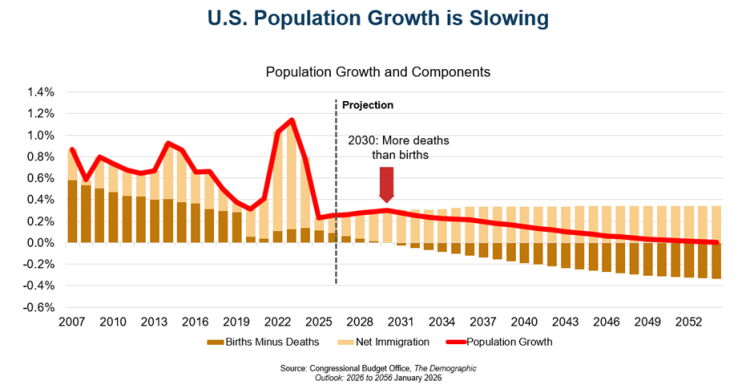
America’s population growth is slowing down—and in the future, it will start moving in reverse. Over the next 30 years, population growth is expected to taper from a modest 0.3% a year to just 0.1% by the late 2030s and 2050s, respectively. By 2056, the country is projected to hit a turning point: the population stops growing altogether and then begins to shrink.
The reason is simple but powerful. Americans are having fewer children, and by 2030, more people will be dying each year than are being born. That leaves immigration as the only thing keeping the population from declining sooner. In fact, without immigrants coming to the United States, the population will start shrinking as early as 2030.
This trend matters because population growth plays a quiet but powerful role in shaping America’s economic future. A growing population means a growing workforce—the engine behind everything the country produces, from goods and services to new ideas and technologies. When the number of working‑age Americans rises, the economy has more capacity to grow. When it stalls or shrinks, the opposite happens: fewer workers must support more retirees, slowing economic momentum and straining programs like Social Security and Medicare (discussed in more detail below).
That’s why today’s demographic trends matter. Birth rates in the United States have been below the replacement level for years, and like many advanced economies, the country is aging. Immigration has helped keep the population growing, but without it, the U.S. would already be on the path toward population decline. As the number of older Americans rises and the share of working‑age adults falls, the nation’s productive capacity will depend increasingly on whether the labor force can keep pace—through immigration, higher workforce participation, or stronger productivity growth.
The Aging of the Population Puts Pressure on Social Security and Medicare
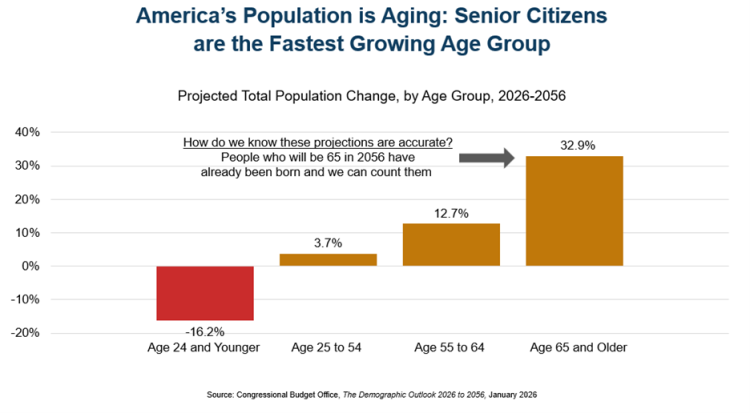
The United States is aging rapidly. Between 2026 and 2056, the number of Americans age 65 and older is projected to grow by nearly one‑third, far outpacing growth in younger age groups. The working‑age population will grow only modestly, and the number of children and young adults will actually decline. This shift means a larger share of the population will be retired and a smaller share will be in the workforce.
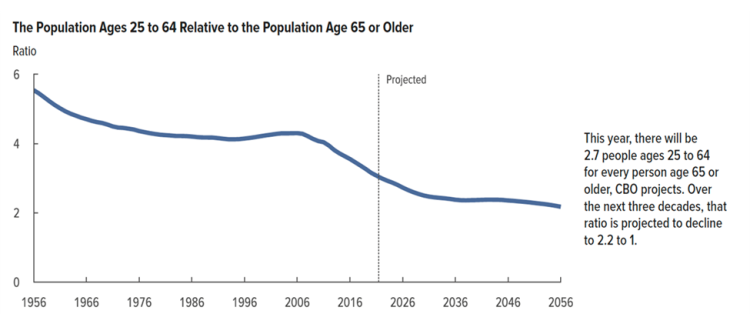
That imbalance has major fiscal consequences. Social Security and Medicare Part A (Hospital Insurance) largely depend on payroll taxes from current workers to pay benefits to current retirees. In the mid-1960s when Medicare was created, there were more than four workers for every retiree, but as the population has aged, especially since the baby boomers began retiring, the ratio of working age population (25 to 64) to retirees (over 65) has fallen to less than three to one, putting increasing pressure on both programs.
Social Security has been running annual cash‑flow deficits since 2010, meaning it pays out more in benefits than it collects in revenue. To cover the gap, it has been drawing down its trust‑fund “reserves,” which are not actual savings but IOUs that the trust fund accrued when the Treasury spent past Trust fund surpluses. From 2010 to 2023, the Treasury had to borrow about $1.08 trillion to redeem these bonds and keep benefits whole.
Source: The Congressional Budget Office, The Demographic Outlook 2026-2056, January 2026
As the population continues to age, these deficits will grow. The trust fund for retirement benefits is projected to be depleted in 2032. Once those IOUs are exhausted, the government cannot borrow further to pay full benefits under current law. Without congressional action, Social Security would be forced to cut all benefits by an estimated 24% to match incoming revenue.
Conclusion
The demographic outlook is a warning. Slowing population growth and a rapidly aging society will shape the nation’s economic and fiscal landscape for decades. A smaller share of working‑age Americans means slower economic growth, tighter labor markets, and greater pressure on programs that rely on payroll taxes to function. These trends don’t unfold overnight, but they compound over time, making early action far more effective than last‑minute crisis management.
The choices policymakers make now will determine whether the United States adapts to these demographic realities or is overwhelmed by them. Strengthening the labor force—through immigration, higher workforce participation, and productivity‑enhancing policies—will be essential. So will long‑overdue reforms to Social Security and Medicare to ensure they remain sustainable for future generations. Demography may set the stage, but policy will decide the outcome.
Continue Reading